Payout
When performing a payout, the customer initiates a payout and then just waits for the funds to be credited to their account. The customer themself doesn't participate in the payout processing procedure.
| Countries and regions | China |
| Payment currencies | CNY |
| Payment amount limits | Contact your key account manager at Flashpay for details. Also you can check the payment amount limits in your project by using Dashboard. |
| Payment processing time | Contact your key account manager at Flashpay for details. |
| Currency conversion | On the Flashpay side |
| Refund |  |
| Onboarding and access fee | Contact your key account manager at Flashpay for details. |
Operations support
| Interfaces | |||
|---|---|---|---|
| Payment Page | Gate | Dashboard | |
| Payout | |
 |
|
You can check the payment amount limits in your project by using Dashboard. To check your payment amount limits, go to Dashboard, select the Projects section, and then click the Payment methods tab.
The following sections provide more information about the payment processing flow and the analysis of completed payments.
Payout by using Gate
General information
To perform a payout by using Gate with the UnionPay payment method:
- Send a request with all the required parameters and signature to the Flashpay URL.
- Accept the callback with the payout result from the payment platform.
The following picture provides the details of the payout processing flow in the UnionPay payment method.
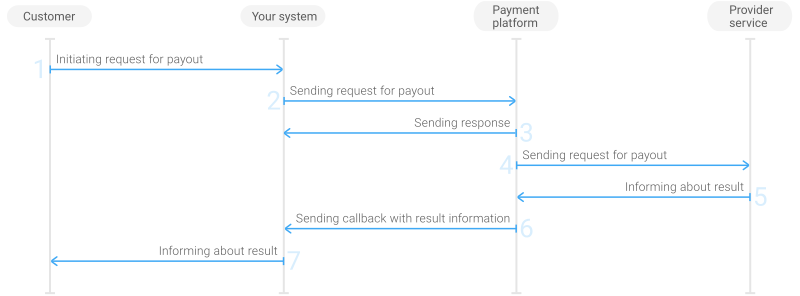
- The customer initiates a payout in your system.
- Your system sends the payout request to the Flashpay payment platform.
- The payment platform sends you a response in which it acknowledges your request and provides the request validation result. (For more information about the response format, see Response format.)
- The payment platform processes the request and forwards it to the provider service.
- The provider service informs the payment platform about the payout result.
- The payment platform sends a callback with the payout result to your system.
- Your system sends the payout result to the customer.
Request
This section provides the instructions on how to build the request for payout with the UnionPay payment method.
| HTTP request method | POST |
| Request body format | JSON |
| API endpoint | /v2/payment/unionpay/payout |
|
||||
|---|---|---|---|---|
| Object | Object/Parameter | Description | ||
general | project_id | Project ID you obtained from Flashpay when integrating. Example: | ||
payment_id | Payment ID unique within your project. Example: | |||
signature | Signature created after you've specified all the request parameters. For more information about signature generation, see Signature generation and verification. | |||
customer | id | Unique ID of the customer within your project. Example: | ||
ip_address | IP address of the customer's device. Example: | |||
first_name | Customer's first name in Chinese. Example: | |||
last_name | Customer's last name in Chinese. Example: | |||
email | Customer's email. Example: | |||
phone | Customer's phone number (up to 13 digits). Example: | |||
identify | doc_number | Number of the customer's Resident Identity Card of the People's Republic of China. Consists of 18 digits or 17 digits and the letter X.Example: | ||
sender | first_name | Sender's first name. Example: | ||
last_name | Sender's last name. Example: | |||
day_of_birth | Sender's date of birth in the DD-MM-YYYY format. Example: | |||
gender | Sender's gender. Possible values:
Example: | |||
phone | Sender's phone number. Example: | |||
citizenship | Sender's citizenship in the ISO 3166-1 alpha-2 format. Example: | |||
country | Sender's country in the ISO 3166-1 alpha-2 format. Example: | |||
address | Sender's address (street, building number, apartment number, etc.). Example: | |||
source_of_income | Sender's source of income. If not passed in the request, the Salary value is used by default.Possible values:
Example: | |||
payment_purpose | Purpose of the payment. If not passed in the request, the Family Maintenance value is used by default.Possible values:
Example: | |||
beneficiary_relationship | Relationship between the sender and the payment recipient. If not passed in the request, the Family value is used by default.Possible values:
Example: | |||
identify | doc_number | Number of the document proving the sender's identity. Example: | ||
doc_type | Type of the document proving the sender's identity. Possible values:
Example: | |||
doc_issue_by | Country that issued the document proving the sender's identity (in the ISO 3166-1 alpha-2 format). Example: | |||
payment | currency | Code of the payment currency in the ISO-4217 alpha-3 format. Example: | ||
amount | Payment amount in minor currency units without any decimal point or comma except for the cases when the currency doesn't have any minor currency units. If the currency doesn't have any minor units (i.e. the number of digits for minor currency units is zero), set this parameter to the amount in the major currency units. To check whether the currency has any minor units, see Currency units and Currency codes. Example: 100.00 CNY must be sent as | |||
card | pan | Customer's card number. Example: | ||
| You can also add any other optional parameters to the payout request, if necessary. For the list of all the parameters available in Gate, see API Reference. | ||||
Here is an example of the data from a request to initiate a payout with the UnionPay payment method:
{
    "general": {
        "project_id": 1234,
        "payment_id": "payment_47",
        "signature": "kUi2x9dKHAVNU0FYldJrxh4yo+52Kt8KU+Y19vySO/RLUkDJrOcZzUCwX6R/ekpZhkIQg=="
    },
    "customer": {
        "id": "customer_123",
        "ip_address": "198.51.100.47",
        "first_name": "爱",
        "last_name": "李",
        "email": "loveli@example.com",
        "phone": "12345678901",
        "identify": {
            "doc_number": "123456789123456789"
        }
    },
    "sender": {
        "first_name": "Mark",
        "last_name": "Cooper",
        "day_of_birth": "10-10-1990",
        "gender": "female",
        "phone": "12345678901",
        "citizenship": "US",
        "country": "US",
        "address": "20 Main St",
        "source_of_income": "Salary",
        "payment_purpose": "Family Maintenance",
        "beneficiary_relationship": "Family",
        "identify": {
            "doc_number": "1234567",
            "doc_type": "Passport",
            "doc_issue_by": "US"
        }
    },
    "payment": {
        "currency": "CNY",
        "amount": 10000
    },
    "card": {
        "pan": "4242424242424242"
    }
}
Callback
In the UnionPay payment method, the payment platform returns the payout result in a callback. For the information about the callback structure, see Callbacks.
The following is an example of a callback body with the information about a successfully completed payout.
{
    "project_id": 1234,
    "payment": {
        "id": "payment_47",
        "type": "payout",
        "status": "success",
        "date": "2024-12-07T19:08:45+0000",
        "method": "unionpay",
        "sum": {
            "amount": 10000,
            "currency": "CNY"
        },
        "description": ""
    },
    "customer": {
        "id": "customer_123",
        "phone": "12345678901"
    },
    "operation": {
        "id": 47,
        "type": "payout",
        "status": "success",
        "date": "2024-12-07T19:08:45+0000",
        "created_date": "2024-12-07T19:08:05+0000",
        "request_id": "1a23456bc7890de",
        "sum_initial": {
            "amount": 10000,
            "currency": "CNY"
        },
        "sum_converted": {
            "amount": 10000,
            "currency": "CNY"
        },
        "code": "0",
        "message": "Success",
        "provider": {
            "id": 12345,
            "payment_id": "123abc123-123",
            "auth_code": ""
        }
    },
    "signature": "U7HQO7ToISZhMPKdM4XrUKQtoYzFvoB3cs9CRd4xeYG2Q=="
}
The following is an example of a callback for a declined payout.
{
    "project_id": 1234,
    "payment": {
        "id": "payment_47",
        "type": "payout",
        "status": "decline",
        "date": "2024-12-07T19:08:45+0000",
        "method": "unionpay",
        "sum": {
            "amount": 10000,
            "currency": "CNY"
        },
        "description": ""
    },
    "customer": {
        "id": "customer_123",
        "phone": "12345678901"
    },
    "operation": {
        "id": 47,
        "type": "payout",
        "status": "decline",
        "date": "2024-12-07T19:08:45+0000",
        "created_date": "2024-12-07T19:08:05+0000",
        "request_id": "1a23456bc7890de",
        "sum_initial": {
            "amount": 10000,
            "currency": "CNY"
        },
        "sum_converted": {
            "amount": 10000,
            "currency": "CNY"
        },
        "code": "20000",
        "message": "General decline",
        "provider": {
            "id": 12345,
            "payment_id": "123abc123-123",
            "auth_code": ""
        }
    },
    "signature": "U7HQO7ToISZhMPKdM4XrUKQtoYzFvoB3cs9CRd4xeYG2Q=="
}
Payouts by using Dashboard
When working with Dashboard, you can process single and mass payouts by using the UnionPay method.
- To process a single payout, open the payout form, specify all required parameters (including the payment method), send a request and verify that the payout has been processed.
-
To process a mass payout, prepare and upload a file with information about all target payouts, send a batch request, and verify that the payouts have been processed.
Use a CSV file structured according to the requirements presented in the Mass payments data section. The payout parameters must comply with the requirements (you do not have to generate a signature because it is specified by Dashboard).
More information about processing payouts by using Dashboard is presented in a separate section.